
For many patients, getting approved for weight loss injections is not the hardest part. Plenty of providers can assess eligibility and issue a prescription. The harder question is what happens after that prescription lands on your doorstep, and if anyone is actually looking after you once the medication starts working.
That question sits at the centre of how Medica Universal is built. Before we prescribe anything, we look at far more than simply checking if you meet a basic threshold. We look at your medical history, your metabolic health, your previous attempts at weight loss, your daily routine, and what is likely to get in your way. A prescription without that groundwork is a guess, not a plan.
In the STEP 1 extension trial, participants regained a mean of two-thirds of their prior weight loss within a year after semaglutide and structured lifestyle support were withdrawn. That is not a reason to avoid treatment. It is a reason to choose a provider who thinks about what comes next, not just what happens on day one.
This article explains what we check before prescribing weight loss injections, and why the real value of the programme is everything that happens afterwards.
The Short Answer
Before prescribing weight loss injections, Medica Universal checks your full medical history, current medications, and if medication is genuinely the right tool for you. But suitability is only the starting point. We also plan how you will be monitored, supported with nutrition, held accountable, and moved safely into maintenance once you are ready. A prescription with no plan for what comes next leaves many patients vulnerable to weight regain once treatment changes or stops.
| What we check | Why it matters |
|---|---|
| Medical history and metabolic health | Confirms medication is safe and appropriate for you |
| Previous weight loss attempts | Identifies what has worked, what hasn’t, and why |
| Current medications | Checks for interactions and safe prescribing |
| Nutrition, lifestyle and routine | Shapes the support plan around real life, not theory |
| Long-term goals and likely barriers | Builds a pathway toward maintenance, not just active weight loss |
Start your assessment with Medica Universal and get a plan built around your full journey, not just a prescription.
Why Prescribing Alone Is Not Enough
Weight loss medications such as semaglutide (branded as Wegovy) and tirzepatide (branded as Mounjaro) work by acting on appetite hormones in the gut and brain, which reduces hunger and slows how quickly your stomach empties. That is genuinely useful. It is also only one part of losing weight and keeping it off.
Medication does not teach someone how to structure meals around lower appetite. It does not manage what happens when a patient hits a plateau, deals with a stressful few weeks, or comes off the medication entirely. These are physiological and behavioural gaps, and they are often where prescription-only services provide less support.
Medica Universal is led by Dr Perminder Sethi, a GP with a Master’s degree in Public Health and Health Promotion, and personal experience of his own weight loss journey. Alongside him, an experienced Diabetes Specialist Nurse supports much of the day-to-day monitoring and check-in process. That combination exists because prescribing safely and supporting someone long-term are two different skills, and both matter.
What “Good” Looks Like in Practice
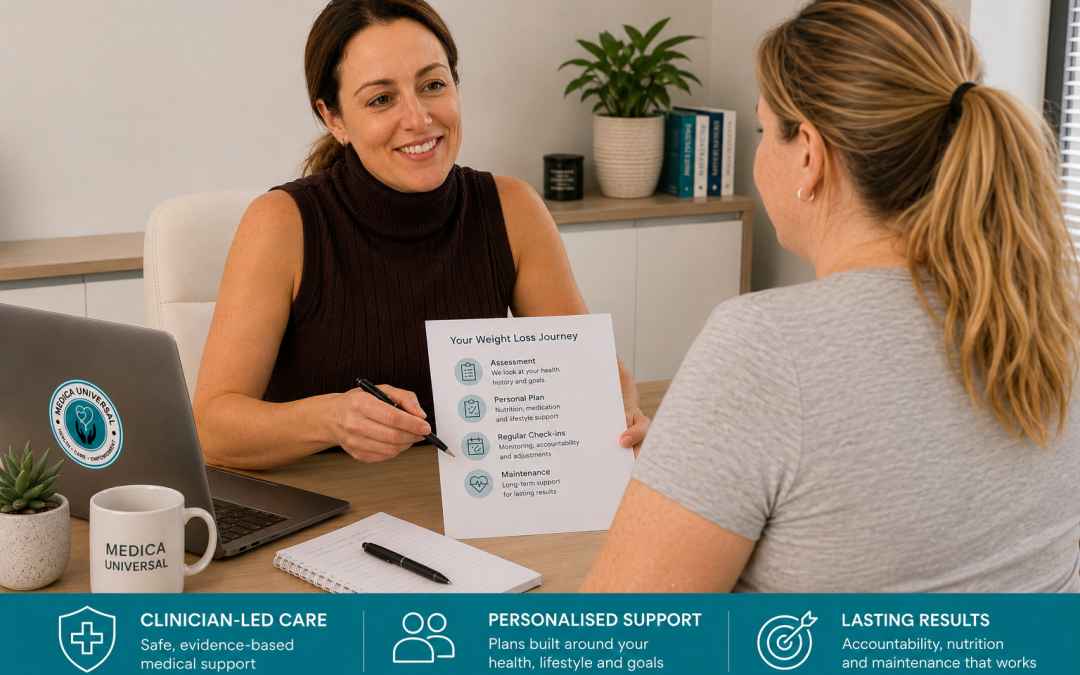
A properly run weight loss programme should look very different from a one-off prescription. In practice, that means:
- A detailed assessment before any decision is made – covering medical history, current medications, and previous weight loss attempts, not just BMI (body mass index, a measure of weight relative to height)
- The right clinician for the right patient – straightforward cases supported through a nurse-led pathway, more complex cases reviewed directly by a GP
- Regular check-ins built into the pathway — monthly during active treatment, with lower-intensity review for suitable stable patients
- Nutrition and lifestyle support alongside medication — ranging from structured guidance to personalised nutrition planning, depending on the programme
- A maintenance strategy agreed from the start – so you know what happens as weight loss slows and what step-down support looks like
If a provider cannot describe what monitoring and maintenance look like for you specifically, that is worth questioning before you commit.
Speak to Medica Universal about how the programme is structured around your goals, not just your starting weight.
Risk Versus Suitability
Being clinically suitable for weight loss injections is not just a BMI calculation. It depends on your health history, your current medications, and what you actually need to succeed long-term.
Some patients have more complex medical histories that need closer GP review rather than an automatic decline. Others may not be suitable for medication at all, and that does not mean support ends. Nutrition, lifestyle, and behavioural strategies can still help someone lose weight safely, which is covered in more detail in our weight loss injections programme.
Suitability is a starting point for a longer conversation, not a single yes-or-no gate.
Pre-Action Checklist
Before you start weight loss injections with any provider, check the following:
- Does the assessment cover your full medical history, not just weight and BMI?
- Is there a named clinician (GP or specialist nurse) reviewing your case?
- Are regular check-ins built into the programme, or only offered if you ask?
- Is nutrition and lifestyle support included, or is medication the only thing on offer?
- Does the provider explain what happens once you reach a stable weight?
Common Mistakes
Judging a provider only on how fast they can prescribe. Speed to prescription tells you nothing about what support exists afterwards.
Assuming medication alone will maintain results. Research consistently shows that structured support significantly affects how well weight loss is maintained after treatment.
Not asking what happens after the active weight-loss phase ends. Many services quietly stop supporting patients once they no longer fit the original prescribing criteria.
Overlooking accountability. Most patients already understand the basics. What is often missing is consistency, and a programme that checks in regularly helps that.
Skipping the maintenance conversation entirely. If a provider cannot describe a step-down pathway, ask before you start, not after.
Different Levels of Support for Different Patients
Not every patient needs the same level of support. Medica Universal offers different programme options depending on where you are in your weight-loss journey and how much clinical or lifestyle support you need.
Care, Empowerment and VIP Priority are GP-led active treatment plans. These are designed for patients who are starting treatment, adjusting dose, actively losing weight or needing closer clinical oversight.
Care provides structured GP-led monitoring during active treatment.
Empowerment adds deeper nutrition and lifestyle support alongside GP-led treatment.
VIP Priority offers closer GP oversight and a higher level of access, with limited spaces.
Health is the nurse-led pathway for patients who are suitable for nurse-level support. It can be used either as an entry point into the programme or as a step-down option once a patient is stable, offering structured clinical support, prescribing review, monitoring and guidance at a lower intensity than the active plans.
This means patients do not all have to start in the same place. Some may begin on a GP-led active plan. Others may be suitable to enter through the nurse-led Health pathway. Patients can also step down or step back up as their needs change.
What to Do Next
- Complete a detailed online assessment, covering your medical history, current medications, and previous weight loss attempts.
- Receive a clinical review from a GP or specialist nurse, matched to the complexity of your case.
- Agree a support plan, including monitoring frequency and the level of nutrition or lifestyle support appropriate for your package.
- Begin treatment with regular check-ins, so any issues are caught early.
- Move into maintenance when ready, with a structured step-down plan rather than a sudden stop.
Start your assessment with Medica Universal today and find out what proper, programme-led support actually looks like.
A Prescription Is Just the Beginning
A prescription is the easiest part of this process. What happens next, including if anyone is checking in, adjusting your plan, supporting your nutrition, and preparing you for maintenance, is where most services fall short.
At Medica Universal, that is the actual programme. Accountability is built in through regular check-ins, not left to chance. Nutrition support helps you manage appetite changes in a way that lasts. Maintenance planning starts from day one, not after you have already lost the weight. And when you are ready to step down from active treatment, there is a structured pathway for that too, rather than a sudden drop in support.
That is the difference between being prescribed a medication and being supported through a genuine health journey. It is also, ultimately, what determines if the results you achieve actually last.
Frequently Asked Questions
What happens if my weight loss plateaus while on treatment?
Plateaus are common and expected. Your check-ins are designed to catch this early, so your clinician can review your nutrition, routine, and dose alongside you, rather than leaving you to work it out alone. A plateau is addressed as part of the programme, not treated as a failure.
Do I need to see a GP for every check-in?
Not necessarily. Straightforward cases are often supported through the nurse-led pathway, with GP oversight behind the scenes. More complex medical histories or changes in your health are reviewed directly by a GP, so you get the right level of input at the right time.
Which Medica weight loss package is right for me?
The right package depends on where you are in your weight-loss journey and how much support you need. Care is designed for patients who want structured GP-led monitoring during active treatment. Empowerment adds deeper nutrition and lifestyle support. VIP Priority offers closer GP oversight and a higher level of access, with limited spaces. Health is the nurse-led pathway for suitable patients who need a lower-intensity level of clinical support, either as an entry point or after completing active treatment. If you are unsure, your assessment helps guide which level of support is most appropriate.
What does step-down support actually involve?
Step-down support typically includes lower-intensity check-ins, ongoing prescribing where clinically appropriate, relapse-prevention guidance, and support as your dose changes. Nutritional guidance may also be included where appropriate. The aim is to keep you supported at the right level, rather than removing support altogether once you reach a stable weight.