
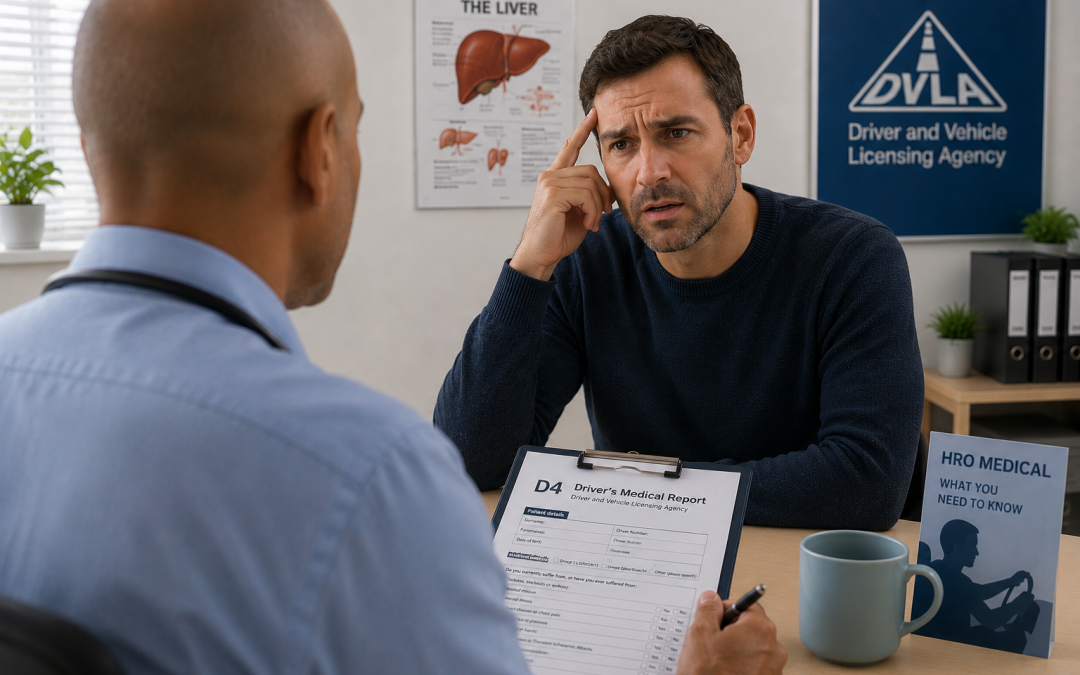
If you have been called for an HRO medical — a High Risk Offender medical assessment required by the DVLA after certain drink-driving disqualifications — you may have been told that a CDT blood test is part of the process. That can feel alarming, especially if you are not sure what it measures or what the result means for your licence.
The CDT test is one of several tools used to help the DVLA assess alcohol use over time. CDT is an important marker, but it is not the only factor in the DVLA’s decision. The result is considered alongside the medical assessment, history, and any other evidence the DVLA reviews. According to the DVLA’s published medical standards, alcohol-related licence decisions are made using a combination of clinical assessment, blood results, and medical history — not a single figure.
Read on to find out what CDT measures, why the DVLA uses it, and what your options are if you want to understand your levels before your formal appointment.
The short answer: CDT is a blood marker that reflects average alcohol consumption over the past two to four weeks. A raised result can indicate heavy drinking during that period. It is one part of a wider clinical picture, and the DVLA — not your examining doctor — makes the final decision about your licence.
Key Takeaways
| Topic | What you need to know |
|---|---|
| What CDT stands for | Carbohydrate-Deficient Transferrin |
| What it measures | Average alcohol intake over roughly 2 to 4 weeks |
| Who decides the outcome | The DVLA, not the examining doctor |
| Can results be affected by other factors | Yes — certain medical conditions can influence CDT levels |
| Can you test in advance | Yes — pre-assessment blood testing is available at Medica Universal |
| Where Medica Universal is based | Portsmouth, with services available to patients across England |
If you are preparing for an HRO medical and want to understand your CDT result before your appointment, Medica Universal offers pre-assessment blood testing and clinical guidance to help you feel informed and prepared.
What Does CDT Stand For?
CDT stands for Carbohydrate-Deficient Transferrin. Transferrin is a protein produced by the liver that carries iron around the body. When alcohol is consumed heavily and regularly, it interferes with how the liver processes this protein. The result is an abnormally low proportion of carbohydrate attached to transferrin, which is what the test detects.
The liver produces transferrin as part of normal daily function. Under healthy conditions, transferrin molecules carry specific carbohydrate chains. When a person drinks heavily over a sustained period, alcohol disrupts the liver’s ability to attach those chains correctly. The body clears these abnormal molecules relatively quickly once alcohol intake reduces, which is why CDT reflects recent drinking patterns rather than lifetime history.
CDT results are reported against the laboratory’s reference range. A result above that range may suggest sustained heavy alcohol intake over recent weeks, but it should not be read in isolation. The DVLA considers CDT alongside the medical assessment, history, and any other relevant evidence before making a licensing decision. CDT levels begin to normalise within two to four weeks of significantly reducing or stopping alcohol.
Why Is CDT Used for HRO Medicals?
When the DVLA requires an HRO medical, it is because a driver has been flagged as potentially high risk. This most commonly follows a drink-drive conviction with a very high alcohol reading, a second drink-drive offence within ten years, or failing to provide a specimen.
The DVLA needs objective evidence that a driver’s relationship with alcohol has changed before reinstating a licence. Clinical interviews and self-reported drinking histories form part of that picture, but biological markers provide additional, measurable information.
CDT is used because it reflects recent and sustained alcohol intake, rather than a single episode. It is not usually changed by abstaining for just a day or two before the test. In the HRO pathway, CDT is considered alongside the medical assessment, your history, and any other relevant information the DVLA reviews before making its decision.
What Does the Test Show?
CDT gives an indication of how much alcohol has been consumed, on average, over the two to four weeks before the blood sample was taken.
A normal result suggests that alcohol intake during that period was within a range consistent with low-risk drinking.
A raised result suggests sustained heavy alcohol intake. It does not prove alcohol dependence, and it does not automatically mean your licence will be refused. Context matters enormously.
There are a small number of medical conditions, including certain liver disorders and a rare genetic variant affecting transferrin, that can produce a raised CDT result in the absence of heavy alcohol use. This is one reason why results must always be interpreted alongside the full clinical picture, not read as a standalone verdict.
The examining doctor’s role is to gather accurate clinical information and report it to the DVLA. The DVLA then reviews the medical report, test results, history, and any other relevant information before making the licensing decision.
Important: A raised CDT result does not mean you will automatically lose your licence. The DVLA considers the full assessment, not one number in isolation.
Can I Have a CDT Blood Test Before My Final HRO Medical?
Yes, and for many patients this can be a helpful step. Medica Universal offers pre-assessment blood testing at our Portsmouth clinic.
Pre-assessment testing gives you a clearer understanding of your current position before the formal medical. It can help you attend with more confidence, ask better questions, and address any relevant health or lifestyle issues in a timely way.
Before booking a pre-assessment test, it helps to keep the following in mind:
- Know your timeline. CDT reflects the past two to four weeks of alcohol intake. Results taken too far in advance may not accurately represent your levels at the time of your formal medical.
- Be honest with your clinician. The pre-assessment is there to help you, not judge you. Accurate information leads to better guidance.
- Bring any relevant medical history. If you have a liver condition or take medications that might affect results, tell your doctor before the test.
- Ask if additional blood tests would be useful. CDT is the key marker used in the HRO pathway, but in a pre-assessment setting your clinician may also suggest other tests, such as liver markers or blood count markers, to build a broader picture of your health before the formal medical.
- If you have been drinking heavily, do not rely on a few days of abstinence immediately before the test to change the result. If you may be alcohol dependent, seek medical advice before stopping suddenly.
Contact Medica Universal to book a CDT pre-assessment blood test or an HRO pre-assessment consultation with one of the team — we are here to help you prepare with clarity and confidence.
What Happens After the Result?
If your pre-assessment CDT result is within the normal range, that can be reassuring, but it does not guarantee the DVLA outcome. It simply gives you useful information about one marker before the formal medical.
If your result is elevated, it does not mean the process is over. It means you have useful, honest information ahead of your appointment. You can discuss the result with a clinician, understand the contributing factors, make lifestyle changes and decide if to allow time before proceeding with the formal medical.
At the formal HRO medical itself, your examining doctor will complete the clinical assessment and submit the required report to the DVLA. Any official laboratory results are used by the DVLA as part of its review process. The DVLA’s medical advisors review the full submission — including CDT, the clinical consultation notes, and any supporting evidence from alternative sources — and make the final decision.
No examining doctor, including those at Medica Universal, can guarantee a particular outcome. What a good clinician can do is ensure your assessment is thorough, accurate, and fairly documented. Patients who understand their results before their formal appointment are better placed to have an informed conversation with their examining doctor and to provide relevant supporting evidence where it exists.
A few things to avoid at this stage: do not assume you understand your position without proper advice if you are concerned about your alcohol history or previous results, do not choose a provider based on cost alone, and do not assume that a single elevated marker tells the whole story. The services at Medica Universal are designed to give you a thorough, clinician-led assessment that reflects the full picture.
Frequently Asked Questions
Is a CDT blood test the same as a breathalyser or urine test?
No. A breathalyser measures alcohol present in the body at a specific moment. A urine test can detect recent drug use over a slightly longer window. CDT is a blood marker that reflects average alcohol intake over a sustained period of two to four weeks. It is a different type of test with a different purpose and a longer detection window.
Will my CDT result be shared with the DVLA automatically?
A private pre-assessment CDT test arranged before your formal HRO medical is for your own information and is not automatically shared with the DVLA. At the formal HRO medical, any required laboratory testing is used as part of the DVLA’s review process. The DVLA reviews the medical report, test results and any other relevant information before making its licensing decision.
Can I appeal if the DVLA refuses my licence based on my CDT result?
If the DVLA refuses or revokes a licence, there may be a right of appeal. In England and Wales, appeals are made through the local magistrates’ court within the relevant time limit, and the DVLA must be informed in writing. Patients should take legal advice if they are considering an appeal.
Will Medica Universal receive my official HRO blood test result?
No. For the formal HRO medical, laboratory results are used as part of the DVLA’s review process and are not normally sent back to the examining doctor for discussion with the patient. The DVLA reviews the medical report, test results and any other relevant information before making its decision. Any update about the licensing outcome comes from the DVLA, not the clinic.
Book an HRO Appointment
Medica Universal offers two routes for patients going through the HRO process.
HRO Pre-Assessment — A consultation with Dr Sethi, CDT blood testing, Portsmouth phlebotomy, and a results review to help you understand your position before the formal medical.
HRO Medical — The formal DVLA-required appointment, carried out by Dr Sethi at Heyward Road Surgery, Southsea. Paperwork is completed and submitted as part of the appointment.
To book either appointment or to ask a question about the process, Contact Medica Universal today. We will confirm which appointment suits your situation and get you booked in as quickly as possible.